

TL;DR (Executive Summary):
- To ensure value creation, leaders must be ready for the expected growth and intense pace.
- Private equity firms must assess leadership immediately.
- Use a 9-blocker format to understand how they rate on the results they deliver and how they deliver them.
- Use an outside third party to obtain an unbiased assessment of your leaders.
- Using a third party, make a clear decision to help grow the leader in a very structured format or make the tough decisions to exit when needed.
- Grow leaders with coaching, mentoring, inside and outside support, and help them network internally.
- Measure leadership growth through financial, customer, talent, and behavioral KPIs.
- Leaders must focus on culture to energize the organization and drive value creation.
The insights and best practices in this blog are drawn from expert panelists, including Mitch Barns, Karl Fessenden, and Dr. D Sangeeta.
What is a Private Equity Leadership Assessment?
Private equity leadership assessment is a structured evaluation of executive capability, adaptability, and cultural fit to determine whether leaders can deliver accelerated value creation under PE ownership.
I recently moderated a panel discussion with leaders in private equity and corporate sectors: Mitch Barns, Karl Fessenden, and Dr. D Sangeeta. We focused on how to assess and develop leaders for value creation rapidly. The key takeaway is that even top leaders need support to meet the rapid growth expectations of private equity firms.
“When a PE firm acquires you, the race begins. You will have to run faster than ever before. It will be super intense,” states Mitch.
Karl adds, “There is always tension because in the PE world, 1+1 = 6. You must be able to make the transition to get the value quickly.”
How Leadership Assessments Can Drive Value Creation
Mitch recommends assessing whether leaders truly understand the PE world and what it means to work in this environment. “PE firms want you to go incredibly fast, and want you to have a plan, but they also want the CEO to be incredibly adaptable, open, and communicative.”
From the CEO’s perspective, Mitch’s advice is to be humble and ask the critical questions, “Why did you buy my firm? What do you consider the starting point, and where do you see us going in the future? How will the PE firm measure financial results?” If CEOs are not asking these questions or demonstrating they don’t understand the answers, that is a signal of potential trouble.
Karl shared that when a PE portfolio company acquires another business to meet growth targets, three signs indicate a CEO may need support: lack of understanding of the thesis, no integration plan, and insufficient focus on culture. “Within days of a deal, you need to know: can your leaders adapt to a high-speed, high-ambiguity environment?”
And from Sangeeta, “If you see leaders are curious and open to learning, that is a good sign. They should be asking questions.”
If a CEO or executive team does not understand the value creation plan—or cannot adapt to PE governance—the risk of value erosion increases rapidly.
Leadership capability is not a soft issue. It is a financial lever.
How to Assess Leadership in a Private Equity Portfolio Company
6-Step Framework for Leadership Assessment
- Conduct structured third-party executive interviews.
- Assess if the CEO has a profile that suggests they have a good chance of succeeding in PE governance.
- Ask leaders to present their understanding of the investment thesis and how performance will be measured.
- Review track record under uncertainty.
- Use a 9-Blocker to rate the executive team on both performance and leadership.
- Identify actions to grow the leaders.
How Can Private Equity PortCo’s Close Leadership Gaps Rapidly?
Panelists agreed that firms should address leadership gaps immediately. Karl states, “You don’t sit on it. If you see a leader who won’t cut it, you act immediately. If you see a leader who’s closed, you need to make that change right away. If, on the other hand, leaders are strong but have skill gaps, bring in outside coaches or consultants like Gotara.”
Sangeeta emphasizes early intervention: “If you have the right person, but there is a skill gap, invest in coaching, mentorship, or consulting support. But do it early—the first 90 days are critical.”

Top 4 Best Practices Effective PE Firms Do to Close Leadership Gaps Quickly
- Utilize the PE firm’s talent operators.
- Beyond the 9-Blocker, assess and categorize leaders: critical, roadblocks, or ready to be motivated.
- Identify key actions for each type, like a bonus tied to integration success metrics, executive mentoring, outside advisors, or an exit plan.
- Do not overlook middle managers; prioritize development at every level.
How Do External Advisors Accelerate Leadership Growth?
Mitch Barns recommends, “First-time CEOs or founders should seek mentors who’ve succeeded in PE-backed environments. Confidential coaching by a third party accelerates adaptation.” Fessenden adds, “External perspectives challenge your assumptions and bring best practices.”
Fessenden observes, “Founder-leaders are often great at building, but scaling requires different muscles. If a founder can’t adapt, make a tough call. Get support from the board, but also outside advisors.” Dr. Sangeeta adds, “Outside advisors can give honest feedback—rapid growth is possible with structured support.”
4 Steps to Implement:
- Pair leaders with external executive mentors.
- Engage with an operator-led consulting company, like Gotara.
- Use external facilitators for alignment sessions.
- Encourage engagement with other companies in the PE’s portfolio.
What KPIs Measure Leadership Growth in PE-Backed Companies?
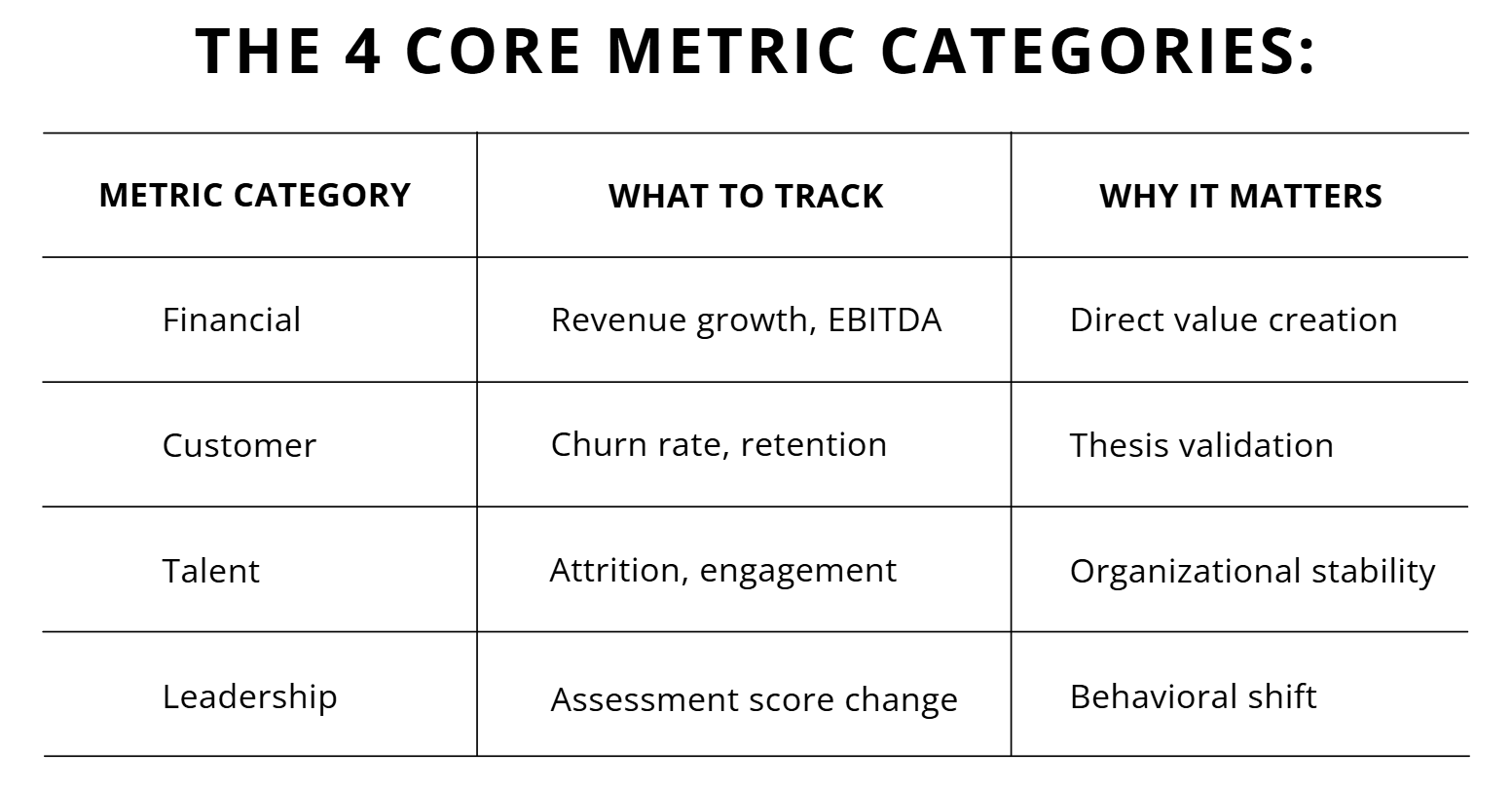
Executive leadership growth, of course, is measured by value creation, the financials. Fessenden: “Focus on KPIs that tie directly to value creation.” Sangeeta highlights three critical metrics: “Track three things relentlessly: business results, customer churn, and talent attrition.”
Additionally, executive leadership growth should be measured by how results are achieved. A strong indicator of the executive’s development is the assessment of the leaders who report to them. If those leaders and their teams align daily work with the company vision and strategy, take initiative, and demonstrate growth, these are strong indicators of executive development.
Fessenden continues, “Always purpose, vision, and values are so important, when you are growing from A to B, what is the thesis and how does it benefit everyone in the company?” Additionally, “Many generations want to work for a company aligned with their values. Performance systems should be based on deliverables and values.”
8 KPIs to Track Leadership Performance During Integration
- Ratings against organizational values, like H, M, L, on the ability to work backwards from the customer.
- Percentage of direct reports with development plans.
- Internal promotion rate from the leader’s team.
- Succession‑readiness scores for key roles.
- Employee engagement and pulse‑survey scores.
- Frequency and completion rate of 1:1s.
- Participation in follow‑up on 360° actions.
- Change in 360° feedback scores on 5–10 priority behaviors (e.g., listening, clarity, coaching, cross‑functional collaboration) over 6–12 months.
When you establish the KPIs, keep tracking simple but rigorous. Use real-time dashboards to monitor financials, customer metrics, talent, and leadership data. Review progress weekly with the leadership team, using KPI data to inform targeted coaching and interventions. Set clear, time-bound priorities at the 30-, 60-, and 90-day marks, and use the data to adjust course. Finally, don’t hesitate to make leadership changes when needed.
Why Is Culture Critical for Value Creation in PE-backed Companies?
A company aiming for rapid organic growth must prioritize its culture. For those expanding through mergers and acquisitions, focusing on culture is essential. Culture is either a multiplier or a destroyer of value.
Karl recognizes, “Tension between the PE firm asking for speed and the fact that the PE firm may not care about leadership development and culture, can create poor results. If they are not operators, they often don’t recognize the impact.”
For integrations, consider cultural compatibility 60 days before close. “Private equity firms may not care about culture; there is no way to measure ROI. But as a board member, I can say culture is just as important as the strategic rationale and the financial case. These three things have equal weight,” states Barns.
“I used to think culture is what you say when you don’t know what you are talking about,” he added, “But then I was converted when I understood culture from a governance perspective.”
He went on to explain that every business, team, or initiative needs to be governed. The classic way to govern is with rules, policies, controls, and processes. This way is very formal, mostly tangible, and needed. The other form of governance is culture—the way people know what the right thing to do is when there isn’t a rule, policy, control, or process. The stronger the culture, the less you need to rely on rules. The weaker the culture, the more rules you need. In other words, the approach people take when no rules exist and no one is watching is a true testament to culture.
“A strong culture can be a great energizer.”
Fessenden asserts, “Culture is your operating system—if it’s incompatible, nothing else will work.” Barns shares, “I’ve seen deals fail because cultural friction was overlooked.” Sangeeta notes, “Combining the best of both cultures creates strength, but only if you’re intentional.”
Clearly articulate how cultural aspects support business objectives. Explain the reasons and highlight culture as a key enabler of success.
5 Ways to Align Culture with Value Creation
- Conduct cultural due diligence pre-close in M&A deals.
- Reframe culture as governance and a strategic priority.
- Map culture directly to business outcomes.
- Involve leaders at all levels across the organization.
- Reinforce norms via recognition and communication.
Frequently Asked Questions (FAQs)
- How soon should leadership assessment begin after a deal closes?
Ideally, assessments are done before close. If not, within the first week, using structured tools and interviews, and it’s recommended to use an external resource. Early clarity prevents prolonged misalignment. - Why use an external resource for leadership assessment?
A third party reduces bias, increases candor, and brings pattern recognition from other PE-backed companies. - What if a leader is a poor cultural fit? Move quickly to address it. Culture clashes are a leading cause of value erosion and integration failure.
- Are external coaches worth the investment?
Yes—panelists agree that external mentors, coaches, and advisors can accelerate change and boost results. - What KPIs matter most in the first 90 days?
Financial performance, customer churn, talent attrition, and measurable leadership behavioral shifts. - Why do so many experts talk about culture, but few people want to work on it?
Because culture is ambiguous, and there is no straight line to ROI. Consider discussing governance as having two parts: policies and culture. Then break it down into management components, such as decision-making and living up to the company’s values. - Why is immediate action so important in private equity?
There is no time to waste since PE investment cycles are compressed. The PE firm will expect significant improvement and change in the first couple of years, when they are investing the most. Expectations are 1+1 = 6.
Final Takeaway from Panelist
The panelists agreed: the speed and effectiveness with which you assess and grow leaders will determine whether your portfolio company creates value or destroys it. As Fessenden put it, “Act quickly, support thoughtfully, and never underestimate the power of culture.” Barns adds, “Don’t overlook the middle—your future leaders may already be there.” Dr. Sangeeta concluded, “With the right structure, feedback, and investment in people, you can build leadership capacity faster than you think.”
Real Impact.
Real Results.
Real Growth.