

TL;DR
- Business transformation is a fundamental step-change in how a company operates, often involving shifts in business models, technology, processes, and culture.
- Change management, on the other hand, is the discipline focused on guiding people through the transitions required by such change.
- While all business transformations require effective change management, not all change management efforts are transformational in scale.
- Most transformation failures stem from neglecting the human side of change—lack of employee engagement, poor leadership, and inadequate communication.
- Leaders often prioritize technical changes over people and overestimate acceptance while underestimating resistance, leading to “change fatigue” and failed outcomes.
- Effective change management, including clear communication, employee involvement, and ongoing support, is critical to transformation success and can significantly increase the likelihood of achieving desired results.
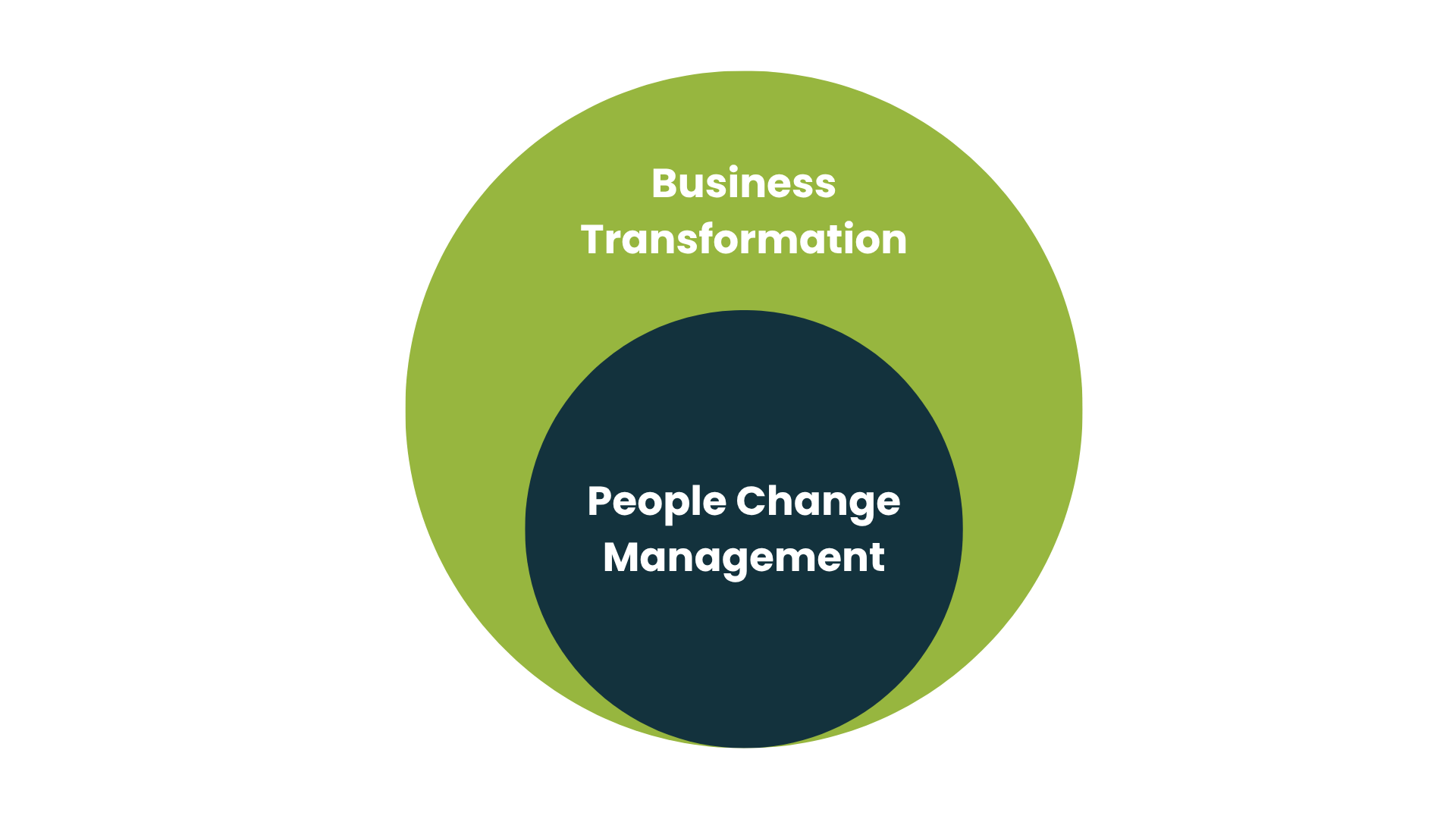
The core difference: Just as all squares are rectangles but not all rectangles are squares, all business transformations require change management, while not all change management efforts are a business transformation.
What is business transformation (with examples)?
Business transformation is a fundamental, step-change shift in a company’s business model, culture, technology, organizational structure, or processes. It can be a reactive or proactive move to remain competitive and grow in rapidly changing markets. Unlike incremental improvements, transformation redefines how a business operates and delivers value. For example:
Example 1: Digital transformation
A large brick-and-mortar retailer launches a modern e-commerce platform, mobile app, and data-driven personalization to become a true omnichannel business.
Example 2: Business model transformation
A traditional software company that sold perpetual licenses with large upfront fees shifts to a subscription / SaaS model with recurring revenue and continuous service.
In both examples, technology and business model changes are important, but the greatest challenge is guiding people to adopt new skills, processes, and mindsets. Sustained transformation depends on team members’ understanding, embracing, and adapting to these changes.
That is where change management comes in.
What is change management, and why does it matter?
Change management focuses on leading the people side of change. It helps those affected understand the reasons for change, its impact, and how to accept and sustain the change. It helps team members let go of previous practices and embrace new ways of working, while maintaining motivation and commitment to the change vision.
It can also be complex because change occurs at the individual level, as each person decides whether to accept and support the proposed change.
Back to the two examples, here is a short list of how team members had to change:
Example 1: Digital transformation (retailer going omnichannel)
How people had to change:
-
- Store associates needed to:
- Shift from in-store selling to supporting online orders, click and collect, and ship from store.
- Use new applications and systems (order management, handheld devices, customer apps) and follow new processes for picking, packing, and returns tied to online orders.
- Change behaviors from “my store, my targets” to shared metrics (e.g., online sales credited to the local store, customer lifetime value, cross-channel satisfaction)
- Merchandising and marketing teams needed to:
- Move from seasonal campaigns to continuous digital experimentation (A/B tests, targeted emails, app notifications).
- Use analytics dashboards instead of intuition, and make faster decisions in shorter planning cycles.
- Collaborate closely with IT and data teams in new cross-functional ways of working.
- Leaders and managers need to:
- Redefine success metrics (e.g., omnichannel margin, digital adoption, NPS) rather than only same-store sales.
- Communicate a new vision and narrative so people stop seeing “online vs store” as competitors and start seeing “one customer, multiple touchpoints.”
- Role model using digital tools themselves (dashboards, collaboration platforms) and actively sponsor training and experimentation
- Store associates needed to:
Example 2: Business model transformation (product company moving to subscriptions)
How people had to change:
-
- Sales organization needed to:
-
-
- Move from big, one‑time deals and a quarterly mindset to “land, expand, and renew” over time.
- Learn to sell value on the total cost of ownership and ongoing outcomes, not just features and discounts.
- Adjust compensation plans and daily behaviors to focus on recurring revenue, renewals, and expansion within existing accounts.
- Product and engineering teams needed to:
- Switch from infrequent major releases to continuous delivery and cloud operations.
- Take on responsibility for reliability, security, and user experience as an ongoing service, not just shipping code.
- Work directly with customers and customer success to prioritize roadmap items tied to customers’ unmet needs and retention.
- Customer success, support, and finance
- Customer success managers become central, proactively driving onboarding, adoption, and ROI conversations, instead of support being a reactive ticket queue.
- Finance and billing teams shift from recognizing large upfront revenue to managing monthly/annual recurring revenue, churn, and cohort analysis.
- Everyone learns new metrics and language (ARR, churn, net retention, LTV) and uses them in decision‑making.
-
How important is change management when embarking on a business transformation?
About 70% of organizational transformations fail to achieve their goals, according to McKinsey & Company. Most failures come from the human element—low employee engagement, weak leadership support, inadequate cultural preparation, and poor communication. Technical challenges are less often the cause.
Effective change management means engaging team members affected by the change from the start and helping them through the transformation. This should include clear communication of purpose, involvement in the design of the future state, and guidance as changes are made on the ground, addressing cultural resistance all along the way. It is essential for success and can deliver up to 143% of expected results.
On the other hand, poor or absent change management produces less-than-ideal outcomes, breeds skepticism, and erodes employee trust, making future change harder.
If effective change management is so clearly vital to successful transformation, why do leaders continue to underestimate its importance—and how can organizations address these blind spots to ensure future success?

Why is change management often overlooked?
During a transformation I led years ago, executives questioned the investment in change management. It was only after long and often difficult conversations that leaders agreed to invest as I suggested. And this is not a one-time event; it happens a lot.
And another transformation earlier in my career, where I failed to convince leaders of the investment need.
The difference between the two experiences? One transformation succeeded, one failed to come close to meeting the expected outcomes.
According to McKinsey, change management is neglected or ineffective in roughly 70% of organizational transformations, leading to failure to meet intended outcomes.
In addition, fewer than half of organizations use dedicated “change agents” to facilitate transformation, despite their proven role in driving success.
Transformations often neglect the “how” (process/people) in favor of the “what” (technology/structure), leading to employee resistance.
Top 5 Reasons Why Change Management is Overlooked in Business Transformation
- Leaders mistakenly prioritize technical, structural, or financial “hard” aspects over the “soft” human elements. This neglect stems from a desire for quick results, an underestimation of employee resistance, and a one-way, broadcast approach to communication rather than engagement.
- Building on this, leaders often assume employees will immediately understand the business case and automatically adapt.
- Additionally, executives tend to focus heavily on the vision (why) and the description of what is changing, but fail to invest in the transition process and execution (how). This creates a gap between strategy and adoption.
- Leaders often underestimate resistance and fatigue—they overlook the emotional impact of change, which can lead to “change fatigue” as employees struggle with constant, rapid transformations.
- Finally, leaders who engage only in short-term thinking prioritize the immediate, tangible costs of training and engagement as extras that can be cut to save on project budgets, ignoring the long-term, expensive costs of failed adoption.
How do transformation leaders make the case for change management?
Leading change is often labeled a “soft skill,” but this is a misconception. Change leadership, grounded in “hard” neuroscience, is one of the most challenging aspects of transformation. But that’s no reason to ignore it. It must be an integral part of your planning.
Top 4 Ways to Convince Leaders to Invest in Change Management
- Present relevant data. Share articles and statistics highlighting the low success rates of transformations without dedicated change management. Reference previous organizational initiatives where outcomes were directly linked to change management practices.
- Address misconceptions about change management. Adapting to change requires altering thought patterns, which involves changes in brain function. The brain remains plastic throughout life, continually forming new connections. Greater neural plasticity makes it easier for individuals to adapt to change. Ground your reasoning in the “hard” science.
- Develop a clear, actionable plan. Define specific steps and tools within your transformation project and communicate expected outcomes at each stage.
- Establish regular checkpoints with executive leaders during implementation. Review both technical and human changes, assess impacts, and update statuses to clarify the relationship between actions and outcomes.
Frequently Asked Questions (FAQs)
- What is the difference between business transformation and change management?
Business transformation is a fundamental, step-change shift in business model, technology, culture, processes, or structure, fundamentally changing how value is delivered. Change management is the discipline of guiding people through these transitions, helping them adapt to and sustain new ways of working. - Why do most business transformations fail?
Most transformations fail due to neglecting the human side of change—lack of employee engagement, weak leadership, poor communication, and underestimating resistance. While companies often focus on technology and strategy, failure typically occurs when employees do not adopt the change. - Why is change management often overlooked during transformation initiatives?
Leaders often prioritize technical or structural aspects, underestimate resistance, focus on vision over execution, and cut engagement efforts to save budget, not realizing the high cost of failed adoption. - How can organizations better support successful business transformations?
Organizations should invest in effective change management by engaging employees early, communicating clearly, involving people in the design of the future state, and providing ongoing support and leadership throughout the change process. - What practical steps can leaders take to make the case for change management?
Leaders can present data showing the impact of change management, address misconceptions with neuroscience, outline actionable plans, and hold regular checkpoints to review both technical and human progress during transformation. - What are the most common change management frameworks?
The Prosci ADKAR® Model is widely used, and several Gotara leaders are certified in it. ADKAR® supports individual change through Awareness, Desire, Knowledge, Ability, and Reinforcement. Since change happens at the individual level, the framework works well across industries and functions. Its main strengths are a practical, employee-focused approach and a shared language for managing change.In addition to ADKAR®, Kotter’s 8-Step Process is a structured, top-down framework for overcoming resistance and achieving lasting transformation. Developed by Harvard’s John Kotter, it emphasizes leadership-driven steps—from creating urgency to embedding change in culture—to implement major initiatives. Gotara’s leaders have also used Kotter’s framework extensively. - How long does a business transformation take?
Business transformations can take from 2 – 12 months or more, depending on scope, complexity, number of team members impacted, robustness of the plan, and many other factors.
Summary
This blog explains the difference between business transformation and change management, emphasizing that while all transformations require change management, not all change initiatives are transformational.
Business transformation involves step-change shifts in a company’s model, technology, processes, structure, or culture, fundamentally altering how value is delivered. Change management focuses on guiding people through these transitions, addressing resistance, and fostering new mindsets and behaviors.
The blog illustrates that the toughest part of transformation is not technology or process, but helping people adapt. It highlights the high failure rate of transformations—often due to neglecting the human side—and details why leaders tend to underestimate the importance of change management, such as prioritizing technical solutions, underestimating resistance, and short-term thinking.
The blog concludes with practical ways to make the case for investing in change management, including using data, neuroscience, actionable plans, and regular leadership checkpoints. Ultimately, it argues that effective change management is essential for transformation success and must be integrated into every major change effort.
Real Impact.
Real Results.
Real Growth.